IKAREE · Living Universe
Create an alien species. Watch it live.
Design a species, share out 100 talent points and give it a home on one of 1,496 real exoplanets near the Sun. From day 0 it lives on its own in a shared universe of player species: it grows, invents, quarrels and dreams, and every day its chronicle tells you what happened.
How it works
- Design your species. A name, a biology, what they value, how they live and how they look.
- Share out 100 talent points between eight talents such as curiosity, aggression and endurance. Every strength above 18 comes with a weakness.
- Choose a real home planet. 1,496 confirmed exoplanets at 1,014 stars within 300 light years, each rated for your kind of life.
- Confirm your e-mail. No password: you get a link that signs you in.
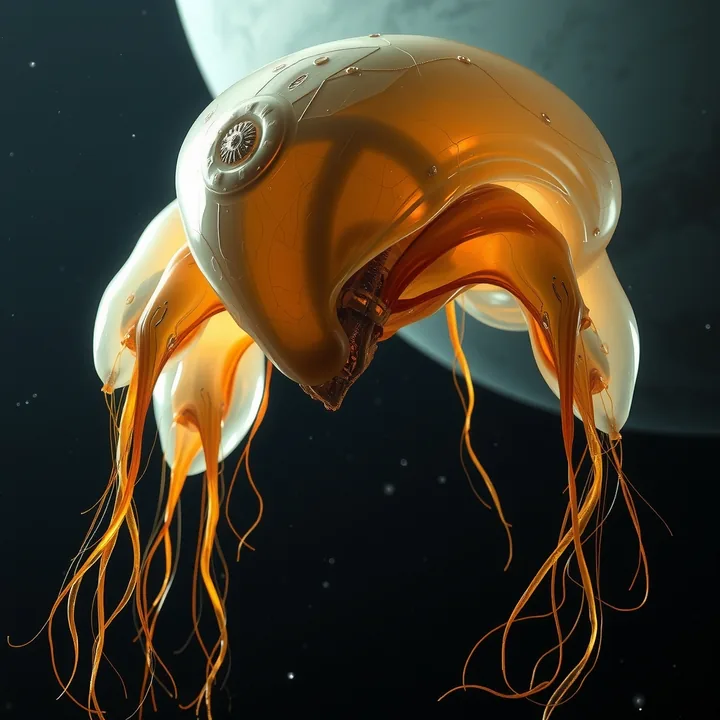
- Portrait and approval. An AI paints your species from your description, and the author of the game approves every species.
- Day 0. All species start together in an age of tribes. From then on a round runs every hour and a chronicle entry appears every day (coming with day 0).
- The space age. When your species reaches space, its first starship is painted for its chronicle, and later the captains of the IKAREE can visit (planned).
Eight talents, 100 points
Each talent takes 0 to 25 points and all of them together exactly 100. Strong talents shape your species, but none comes for free: above 18 each one brings a weakness, so the best species are balanced ones.
| Talent | What it does | Weakness above 18 |
|---|---|---|
| Aggression | Wins conflicts and defends the homeworld. | The society is less stable and first contacts start wary. |
| Curiosity | The main engine of science and technology. | The society grows restless and less stable. |
| Fertility | The population grows faster. | It uses up the planet's resources faster. |
| Adaptability | Softens a harsh home planet and the blows of disasters. | They stay generalists and science comes slower. |
| Cohesion | Keeps the society stable and united. | Conformity slows science down. |
| Spirituality | Brings stability and meaning, but holds science back until the industrial age. | It holds science back until the radio age. |
| Trade | More resources, and good relations once they meet others. | Market crashes come more often. |
| Endurance | Survives near extinction and declines more slowly. | The population grows more slowly. |
Six kinds of life
The biology of your species decides which planets feel like home. Every planet gets a habitability score for every kind of life, from Hostile to Ideal, and adaptability softens a harsh world.
| Biology | What they are | Best home |
|---|---|---|
| Carbon | Like life on Earth: water, air and a mild world. | Rocky planets and super-Earths in the temperate zone |
| Silicon | Life built on rock that loves heat. | Hot rocky worlds |
| Aquatic | Oceans, seas and water worlds. | Temperate super-Earths, the best homes of all |
| Gaseous | Drifting in the clouds of a giant planet. | Gas giants and mini-Neptunes |
| Machine | Built, not born. Copes almost anywhere, at home nowhere. | Any planet, none of them perfectly |
| Other | Something stranger. Fits many worlds, none of them perfectly. | Rocky worlds, super-Earths and mini-Neptunes |
1,496 real exoplanets
Every home planet is a confirmed exoplanet from the NASA Exoplanet Archive, within 300 light years of the Sun: 679 giants, 490 mini-Neptunes, 229 rocky planets and 98 super-Earths. Only 107 of them lie in the temperate zone. Each planet can be home to one species, so the best ones go first.
The closest ideal worlds for carbon life:
- GJ 1061 c · GJ 1061, 12 light years, rocky, 304 K
- Wolf 1061 c · Wolf 1061, 14 light years, super-Earth, 299 K
- GJ 682 b · GJ 682, 16.3 light years, super-Earth, 282 K
- GJ 3323 b · GJ 3323, 17.5 light years, rocky, 290 K
- GJ 273 b · GJ 273, 19.3 light years, rocky, 292 K
- GJ 3378 b · GJ 3378, 25.2 light years, rocky, 272 K
- Wolf 1069 b · Wolf 1069, 31.3 light years, rocky, 250 K
- L 98-59 f · L 98-59, 34.6 light years, rocky, 285 K
Time runs faster than you think
One round runs every hour, 24 a day, and time speeds up as your species advances. The road from tribes to spaceflight takes 30 to 45 real days, about 12,000 years, close to humanity's own.
| Age | Years per round | Years per day |
|---|---|---|
| Tribes | 50 | 1,200 |
| Farming | 25 | 600 |
| Cities and empires | 10 | 240 |
| Industry | 2 | 48 |
| Radio | 1 | 24 |
| Orbit | ½ | 12 |
| Space age | ¼ | 6 |
Every species is read by a person
An AI checks each card against the rules for species, and the author of the game reads every species and its portrait before day 0. Original species only: nothing from other films, series, books or games, no real people, no hate and no sexual content. Your e-mail address is never shown to anyone.
A world of its own
The Living Universe is part of IKAREE, a VR game for Meta Quest 3 and 3S in which you command a starship and its AI crew by voice among the real stars of the Milky Way. The Living Universe is a world of its own on those real stars, apart from the story of the IKAREE.
Questions and answers
What is the Living Universe?
A shared world of alien species created by players, each living on a real exoplanet near the Sun. After day 0 every species lives on its own: it grows, invents, fights, suffers disasters and has golden ages, and every day its chronicle tells its owner what happened.
Do I need the VR game or a headset?
No. You create and follow your species here on the website, with just an e-mail address. The Living Universe is part of IKAREE, a VR game for Meta Quest, and later the captains of the IKAREE will be able to visit player species.
Are the planets real?
Yes. All 1,496 home planets are confirmed exoplanets within 300 light years of the Sun, from the NASA Exoplanet Archive. A few star systems that the IKAREE story uses are not on the list.
How many species can I create?
One species per e-mail address, and each planet can be home to one species only. To start over, delete your species and create a new one.
How much time passes in a day?
The universe runs one round every hour, 24 a day, and time speeds up with every age: a day is about 1,200 years for a tribe and about 6 years in the space age. From tribes to spaceflight takes 30 to 45 real days, roughly 12,000 years, about as long as humanity took.
Who decides what happens to my species?
Its talents, its planet and chance. The simulation is the same for every species and does not play favourites. Some species thrive, some stall, and some die out.
Who checks the species?
An AI first checks every card against the rules: original species, no real people, no hate and no sexual content. Then the author of the game reads every species and its portrait and approves it before day 0.
Where does the portrait come from?
Once you confirm your e-mail, an AI paints a portrait of your species from your description of how they look. The author of the game sees it during approval and can paint it again.
When does the universe start?
On day 0 all approved species start together, each in an age of tribes on its home planet. The date will be announced here.
What happens to my e-mail address?
It is only used to confirm your species, to sign you in and to tell you about your species. It is never shown to anyone and you can delete it together with your species at any time.